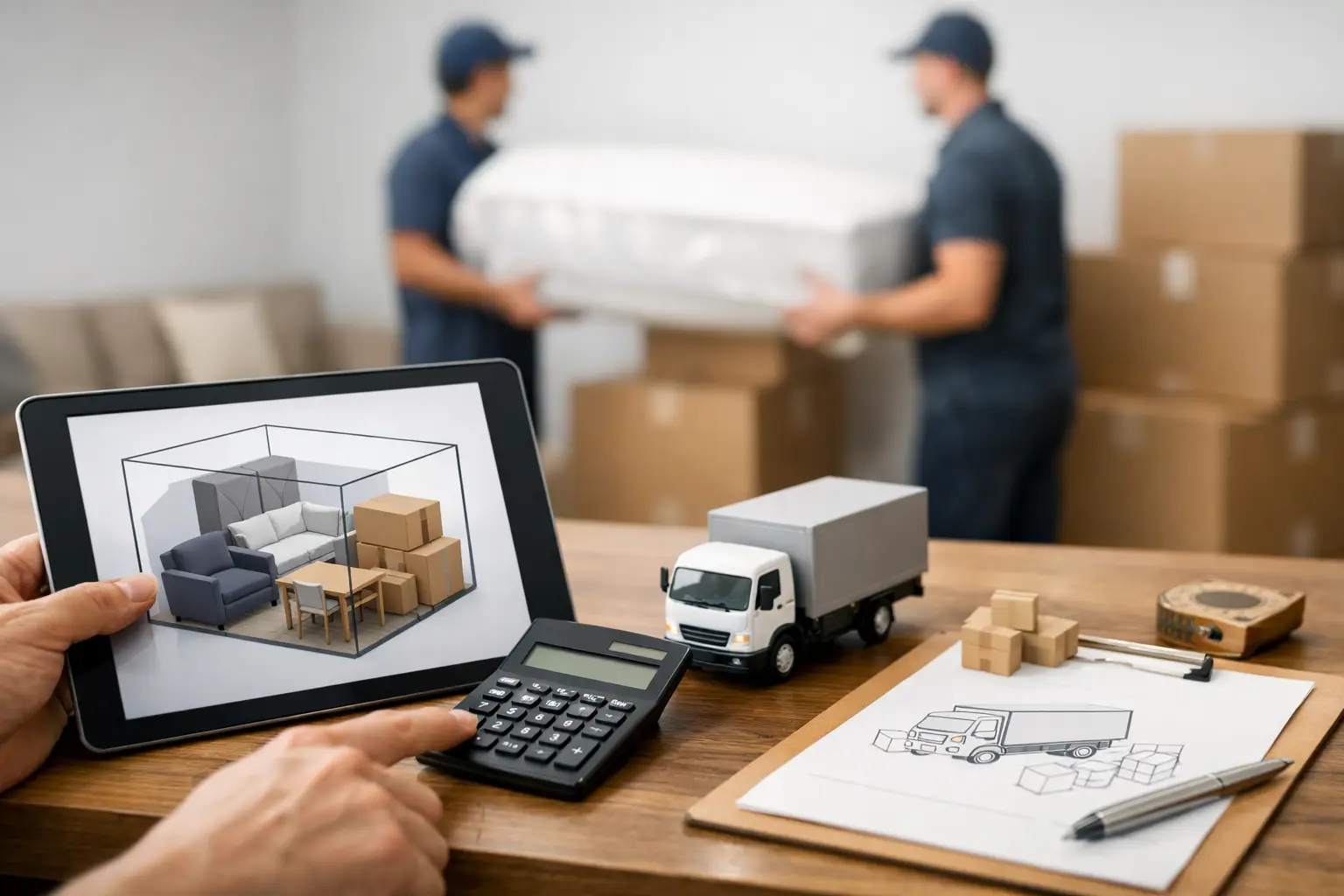
A three-seat sofa, a dismantled bed and six boxes can sound like a straightforward collection. Then the driver arrives with a small van, the sofa will not stand safely, and the job needs a second vehicle or journey. A furniture delivery volume calculator helps prevent that situation before you request quotes or book a collection.
It converts the items you need moved into an estimated volume, usually measured in cubic metres (m³). That estimate gives you a practical starting point for choosing a suitable vehicle, explaining the job clearly and comparing delivery prices on a like-for-like basis. It is not a substitute for careful loading or specialist handling, but it can save time, cost and avoidable stress.
What a furniture delivery volume calculator tells you
Every van has a finite load area. Volume is the amount of three-dimensional space your furniture occupies inside it. A calculator estimates this by using typical dimensions for common household items, or by multiplying an item's length, width and height.
The basic calculation is:
Length x width x height = volume
For example, a bookcase measuring 1.8 metres high, 0.8 metres wide and 0.3 metres deep has a volume of 0.432m³. Add the volumes for each item and you have an approximate total for the delivery.
That total helps match a job to a vehicle category. A few chairs and a bedside cabinet may fit in a small van. A dining table, mattress, wardrobe and packed boxes may need a medium or large van. For a flat move or several bulky pieces, the volume can point towards a Luton van or a removal vehicle with a tail lift.
The estimate also makes quotes more meaningful. If one provider has priced for a small van and another has allowed for a Luton van, their figures are not directly comparable. Supplying a clear item list and volume estimate gives delivery firms a better basis for pricing the work.
Why volume is not the whole delivery plan
A calculator is useful, but it cannot see your stairwell, parking bay or lift. Furniture has awkward shapes, fragile edges and handling requirements that a simple cubic-metre figure cannot fully capture.
A large corner sofa is a good example. Its calculated volume may look manageable, but it can be difficult to stack around, may need to travel upright, and might not pass through a narrow hallway in one piece. A glass display cabinet needs protection and a secure position in the van, leaving space that cannot be used for heavy boxes. A king-size mattress is light for its size, yet it takes up a broad section of the load area.
Think of the calculator as a capacity check, not a loading promise. The final vehicle choice depends on the item dimensions, how well items can be stacked, safe weight distribution and access at both addresses.
Volume, weight and loading space are different things
Two loads can have the same volume and require different vehicles. A room full of cushions, lampshades and boxed bedding is bulky but relatively light. Solid wood furniture, filing cabinets, gym equipment or stone-topped tables can be compact and very heavy.
Drivers must load safely. Weight should be distributed properly, items must be secured, and a vehicle must not exceed its legal payload. If your furniture includes particularly heavy pieces, state this when asking for a quote rather than relying on volume alone.
Loading space matters too. Vans have wheel arches, bulkheads and doors that reduce the useable shape of the cargo area. A listed internal capacity is helpful, but it does not mean every cubic metre is equally easy to fill.
How to calculate furniture delivery volume accurately
Start by creating an item-by-item list. Avoid descriptions such as “living room furniture” or “a few boxes”. A delivery provider needs to know whether that means a two-seat sofa and TV unit, or a full room including bookcases, a coffee table, armchairs and twelve cartons.
For each item, select the closest match in the calculator or measure it at its widest points. Measure in metres where possible, including legs, fixed arms and protruding tops. If you measure in centimetres, divide each measurement by 100 before multiplying. A cabinet measuring 120cm x 40cm x 80cm becomes 1.2m x 0.4m x 0.8m, which equals 0.384m³.
Use the packed size, not the empty-room appearance. Boxes often account for more van space than customers expect, particularly when moving kitchenware, clothes, books and small electrical items. Count each box and choose the box size as accurately as possible.
Leave sensible spare capacity. A load rarely packs as neatly as a calculator suggests, and drivers need room to protect furniture with covers, blankets and straps. For a straightforward collection of regular-shaped items, a modest allowance may be enough. For mixed furniture, fragile pieces or a move involving lots of boxes, allowing extra space is the safer choice.
Items that commonly change the van size
Some items have an outsized effect on a furniture collection. Include them early, rather than adding them after you receive a price.
- Sofas, especially recliners, sofa beds and corner units
- Mattresses and bed frames, including headboards
- Wardrobes, tall cabinets and large bookcases
- Dining tables, particularly when they cannot be dismantled
- American-style fridge freezers and washing machines
- Garden furniture, exercise equipment and large mirrors
Where furniture can be dismantled safely, say so. Removing table legs, separating a bed frame or taking shelves out of a cabinet can make loading easier and reduce the risk of damage. However, dismantling takes time, requires suitable tools and may affect the labour cost. Flat-pack furniture is not always designed to be taken apart repeatedly, so do not force it simply to fit a smaller van.
Do not forget access and collection details
A correct volume estimate can still lead to a difficult job if the driver cannot park near the property or move an item through the building. Give the collection and delivery postcodes, floor numbers, lift availability, stair details and any parking restrictions. Mention narrow entrances, low bridges, gated estates or long walks from the vehicle to the door.
For furniture bought from a marketplace or shop, confirm whether it is already dismantled and whether anyone can help at collection. A collection from a ground-floor house with driveway parking is different from collecting a wardrobe from a fourth-floor flat with no lift.
If an item is high-value, antique or unusually fragile, describe its condition and material. Professional handling may involve additional wrapping, two-person carrying or a specialist vehicle. These details are not obstacles to booking. They are what allow the right service to be arranged from the start.
Using your estimate to compare delivery quotes
Once you have a volume figure and full item list, request quotes using the same information each time. Include collection and delivery addresses, preferred date, access notes, whether you need help loading and unloading, and any assembly or dismantling requirement.
The lowest price is not always the lowest overall cost. A quote that assumes kerbside collection, one person or a smaller van can change once the job details are clarified. Check what is included: vehicle size, number of movers, loading assistance, protective equipment, insurance arrangements and waiting time where relevant.
For a single item, such as a chest of drawers or a two-seat sofa, a dedicated furniture delivery may be the simplest route. For several items or a partial home move, a larger removal service can offer better value because the labour and vehicle are planned around the full load. It depends on the volume, distance, access and how quickly you need the delivery completed.
Movers Exchange helps customers turn those practical details into clearer transport choices, whether the job is one bulky item, a student move or a full household relocation. Providing an accurate inventory gives the delivery team the information needed to match the job with suitable capacity.
When to increase your estimate
Increase the estimated volume if you are unsure whether items will dismantle, if you have not counted every box, or if the collection includes loose household goods. It is also sensible to allow more room where a van may carry blankets, packing materials or equipment for safe handling.
Be especially cautious with “collection only” purchases. Photos can make furniture look smaller than it is, while seller descriptions may not include dimensions. Ask for measurements before booking. If these are unavailable, send clear photos and describe the item honestly, including whether it is a solid unit, a sectional piece or stored in a garage or loft.
A little extra space is usually cheaper than a failed collection, a second journey or a last-minute vehicle upgrade. Use the calculator to get organised, then treat the item list and access information as equally valuable parts of the booking. The right van is not just the one with enough cubic metres - it is the one that can collect, protect and deliver your furniture without making moving day harder than it needs to be.